
Don’t rule yourself out just yet… Let’s sniff out the facts behind some dog volunteering myths.

By popular demand, our Tail or Tale quiz is back!
Last time, we tackled some of the biggest myths about assistance dogs. This time, we’re sniffing out the truth behind some of the most common misconceptions about volunteering with dogs at Canine Partners.
Think you know what’s fact and what’s fiction? Let’s find out which assumptions are tails (True) and which are tales (Myth).
1. Living in a city means you can’t volunteer with dogs… Truth or Myth?
Myth!
The truth is, you don’t need a rural postcode to volunteer with a dog.
In fact, many of our volunteers live in towns and cities, and we’re currently recruiting for roles in several urban areas. What matters most is finding the right match and ensuring you have a secure garden where a dog can spend time safely. Renters can also volunteer with landlord permission.
Don’t let your location put you off applying! Check out the towns and cities where we’re currently recruiting Puppy Training Volunteers here.
2. Many costs are covered by Canine Partners… Truth or Myth?
Truth!
Many people assume they’ll need to fund a future assistance dog’s journey themselves.
Not quite, Canine Partners provides a starter pack and covers food and veterinary costs. Travel costs for arranged training sessions and classes are also covered.
The biggest contribution you make isn’t financial — it’s the time, care and commitment you give to help a puppy thrive.
3. Having a job means you can’t volunteer with Canine Partners… Truth or Myth?
Myth!
Having a job doesn’t automatically mean volunteering with Canine Partners isn’t an option. Many of our volunteers successfully balance caring for a dog alongside part-time or flexible work.
The key is having enough time to care for, train and support the dog, while providing the supervision and consistency they need. For volunteers caring for puppies, it’s important to note that they shouldn’t be left alone for more than four hours in a day, and any time spent alone should be introduced gradually with support from our expert trainers.
In some cases, dogs may be able to attend work with you. This will depend on your workplace, the individual dog, and the requirements of the role. Our team can help assess whether this is a suitable option.
Ultimately, it’s about finding the right volunteering role for your circumstances and having the time and commitment needed to support a Canine Partners dog. Please get in touch to discuss your situation.
4. You need to be a dog expert to volunteer with Canine Partners… Truth or Myth?
Myth!
No professional dog training qualifications? No problem.
You don’t need to be a dog expert, and you don’t even need to have owned a dog before. Our expert team provides ongoing support, guidance, and training to help volunteers develop the skills they need.
What matters most is enthusiasm, commitment and a willingness to learn. We’ll be there to support you every step of the way.
5. Having your own dog means you can’t volunteer with a Canine Partners dog… Truth or Myth?
One of the biggest myths we hear is that you can’t volunteer if you have a much-loved dog of your own. In fact, it’s often beneficial for a puppy to grow up around other animals, helping them develop confidence and social skills.
Many of our volunteers already have dogs, and some even have two. If your dogs are over 18 months old, have lived with you for at least six months, and have a suitable temperament, you may be able to volunteer. We also welcome applications from households with other pets, as we’ll assess every home individually to find the right fit.
We’ll work with you to make sure a Canine Partners dog can settle safely and happily into your household.
6. I love going on regular holidays, so I can’t volunteer with a Canine Partners dog… Truth or Myth?
This one is a little more complicated…
Regular absences will make it difficult to meet the needs of the role, but the occasional holiday can usually be planned for. In these situations, we can arrange for the dog to stay with another approved volunteer or member of the Canine Partners team.
Future assistance dogs need consistency, routine and ongoing training, so if you’re away from home frequently or for extended periods, a role volunteering with dogs may not be the right fit.
The good news is that Canine Partners has plenty of other volunteering opportunities that don’t involve having a dog at home, so you may find another way to volunteer that’s right for you.
7. Having young children means volunteering isn’t possible … Truth or Myth?
Myth!
Having a young family doesn’t automatically rule you out of volunteering with Canine Partners.
Many of our volunteers fit their role around family life, and positive experiences with children can be valuable for some dogs. Every household is different, so we will work with you to understand if volunteering with dogs is right for your circumstances.
8. I’m hoping to get my own dog soon, so volunteering with Canine Partners dogs isn’t an option for me right now… Truth or Myth?
Truth!
If you’re planning to welcome a dog of your own soon, dog volunteering roles may not be the best fit right now.
Any pet dogs already living in your home must be at least 18 months old and have been with you for at least six months before you can volunteer with one of our dogs.
But that doesn’t mean you can’t get involved with Canine Partners. There are plenty of other opportunities to support our work, develop new skills, and become part of our community.
9. Being at university means you can’t volunteer with Canine Partners… Truth or Myth?
Myth!
Being a student doesn’t automatically rule you out of volunteering. While it won’t be the right fit for everyone, some volunteer roles can work alongside studying, depending on your circumstances and living arrangements.
One of our amazing volunteers, Charleigh, even cared for a Canine Partners dog while at university, with her four-legged friend joining her at graduation! Look at Charleigh’s volunteer journey to see what’s possible.
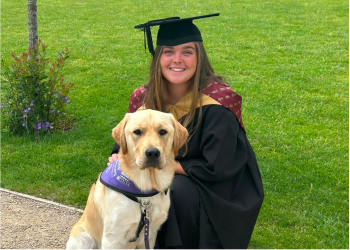
Image: Puppy Training Volunteer Charleigh and Winstone
10. I’d get too attached to a Canine Partners dog to give them back… Truth or Myth?
This one is a little more complicated…
Let’s be honest, most volunteers do form a special bond with the dogs in their care, so saying goodbye can be emotional.
But alongside that comes an enormous sense of pride. Volunteers know the‘ve helped a dog develop the skills, confidence and experiences needed to take the next step towards changing a disabled person’s life.
Saying goodbye isn’t easy, but many volunteers find the pride outweighs the sadness. Many go on to support numerous dogs and take on different volunteer roles along the way.
Canine Partners also keeps volunteers updated with photos and progress updates, allowing them to follow each dog’s journey. Some volunteers may also choose to reconnect with a dog at one of our Partnership Days. This is an opportunity to celebrate our incredible partnerships and everyone who played a part in making them possible.
And remember, support is always available. We offer dedicated bereavement support for volunteers who may find saying goodbye difficult.
“My job is to love and care for the puppy, giving them the very best start in life possible, so that when it is time to say goodbye, I can be proud in the knowledge that I have done my very best.” Julia, Puppy Training Volunteer.
How many did you get right?
If some of these myths had you fooled, you’re not alone. The good news is that volunteering with Canine Partners is often more flexible than people think.
Whether you’re a student, a parent, a dog owner, or working full-time, there could be a role that’s right for you.
And it’s not just dog-based roles. From fundraising and events to administration, awareness-raising, and behind-the-scenes support, there are plenty of ways to get involved.
Hopefully we’ve helped separate the myths from the facts. Now it’s time to find the role that’s right for you.